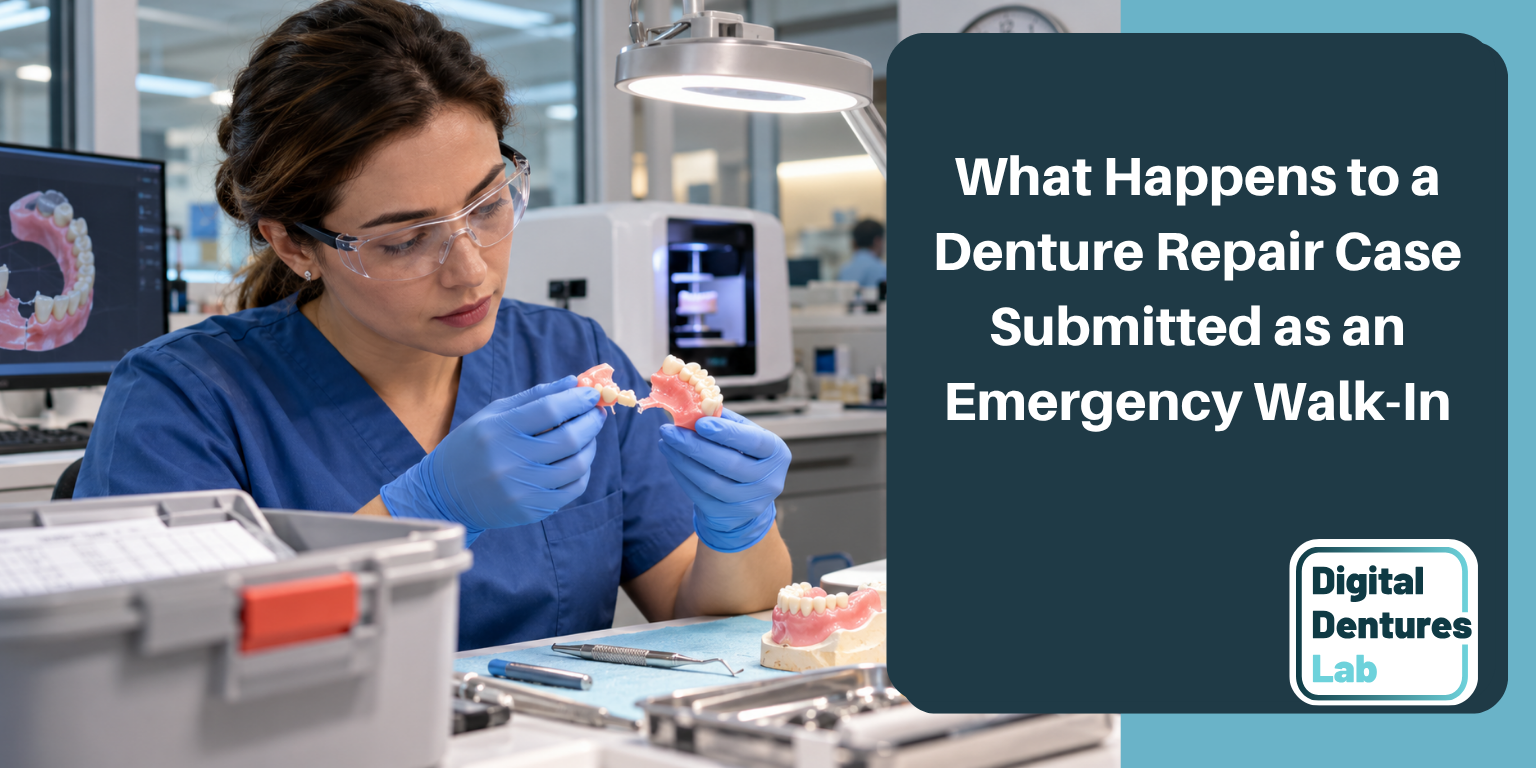



A patient walks into the practice with a fractured denture base, a missing tooth, or a separated component and wants to know how quickly it can be fixed. Sometimes travel, a family event, or another deadline makes the situation more urgent. The dentist has to give an answer before the laboratory has even seen the prosthesis.
Most practices already have a routine repair process, but an emergency denture repair raises a different question: what changes when the case is urgent, and what can the practice realistically promise the patient? Here, “emergency walk-in” means a patient presenting to the dental office; the dentist evaluates the prosthesis and decides whether it can be managed in-office or should go to the laboratory.
The answer depends on the damage, the repair required, and the time needed to move the prosthesis to and from the lab. Understanding those steps helps the practice set a realistic expectation.
“Emergency” is a practical description, not a single repair category. A cracked or fractured base, a broken or lost denture tooth, or a separated component can all create an urgent denture repair when the patient cannot function comfortably or has a time-sensitive need.
Urgency does not necessarily change the repair technique. It changes how quickly the case needs to be evaluated and whether expedited handling is available. Routine relines, minor adjustments, and nonurgent maintenance can usually remain on the normal schedule unless the clinical situation requires otherwise.
The first decision is whether the damage can be managed safely in the office or needs laboratory repair. Minor adjustments may be handled chairside when appropriate. A major base fracture, framework damage, tooth replacement requiring shade and contour matching, or a case in which fit or occlusion must be re-established is more likely to require laboratory evaluation.
Repair technique depends on the material and component involved. Acrylic-base repairs are generally resin-based, while metal framework components may require a metal-specific method such as laser welding. Published repair-strength research shows that strength varies with material, joint design, and surface treatment; laser-welding research applies specifically to metal alloys rather than acrylic denture bases.
When structural integrity, fit, occlusion, or component replacement is uncertain, laboratory evaluation is generally the safer route.
The condition of the existing denture matters too. If the prosthesis no longer fits acceptably, the damage has altered the occlusion, or a component cannot be replaced predictably, the dentist may need to provide additional records or reconsider whether a simple repair is appropriate. That clinical decision remains with the prescribing dentist.
A rush label is useful only when the laboratory also knows the damage, requested repair, and patient deadline. Before promising a return time, the practice should confirm whether the case qualifies for expedited or same-day handling.
Digital Dentures Lab states that expedited repair options are available for eligible cases and that same-day repairs are available for select locations and cases. Because eligibility depends on the specific repair and location, the practice should confirm timing before promising a return date.
What should not change is the repair standard. Urgency can shorten waiting time where possible, but it should not eliminate steps needed to restore the prosthesis appropriately.
For the office, the handoff is straightforward: identify the damage, state the deadline, and obtain confirmation that the lab can accept the case on that timeline. That gives the patient a concrete answer without requiring the practice to know how the laboratory organizes its internal schedule.
Repair cases work from an existing prosthesis rather than requiring a completely new appliance, but that does not make every urgent case a same-day case. The published denture repair turnaround time from Digital Dentures Lab is 24 to 48 hours for most repairs, depending on complexity. The same page also states that same-day service is available for eligible locations and cases.
A same-day denture repair may be realistic for an eligible local case, but a prosthesis that must travel to the lab and back still has transit time. Digital Dentures Lab includes free two-day FedEx shipping nationwide, so laboratory processing time and total door-to-door time are not the same.
“Emergency,” “expedited,” and “same-day” should not be treated as interchangeable. Repair type, complexity, location, shipping, and the time the lab receives the prosthesis can all affect the return date.
Send the damaged prosthesis with a clear prescription describing the problem and requested service. If a tooth is missing or broken, include the tooth position and available shade information. If the patient has a fixed deadline, state the date and time directly.
A vague “rush” note can still slow intake if the technician has to call for a missing tooth position, shade, or deadline. Complete case information is more useful than urgency alone.
Before sending an urgent case, the practice should confirm whether the damage is repairable, whether expedited handling is available, the expected return date, and the cost. Those details are especially important when shipping is involved.
A reliable emergency denture repair service should also make clear what information is needed at intake and whether the quoted time refers to laboratory processing or the full round trip.
Digital Dentures Lab lists repair pricing starting at $140 for repairs and relines, crack and fracture repair, CAD/CAM shade-matched tooth replacement, same-day options for eligible cases and locations, and free two-day FedEx shipping. The company states that its restorations are produced in the USA.
For an emergency denture repair, the practice needs to evaluate the damage, send complete information, and confirm timing before giving the patient a return date. That is more useful than relying on the word “emergency” alone.
For an urgent case, contact Digital Dentures Lab to confirm repairability, timing, and shipping before quoting the patient a completion time.
An emergency repair is a time-sensitive case in which denture damage leaves the patient without acceptable function or creates a pressing need. Fractured bases, broken or lost teeth, and separated components may qualify, but expedited handling still depends on the specific case.
Digital Dentures Lab states that most repairs can be completed within 24 to 48 hours depending on complexity, with expedited options for eligible cases. Shipping and intake timing also affect the total turnaround.
Sometimes. Digital Dentures Lab states that same-day repairs are available for eligible cases and select locations. Shipped cases still require transit time.
Send the damaged prosthesis and available pieces, a clear description of the damage, the requested repair, shade information if a tooth must be replaced, and the patient’s actual deadline.
Digital Dentures Lab lists repairs and relines starting at $140. Confirm the final cost, including whether any expedited-service charge applies, before quoting the patient.

Get updates, case details, and lab innovations to support your practice and patient outcomes.