
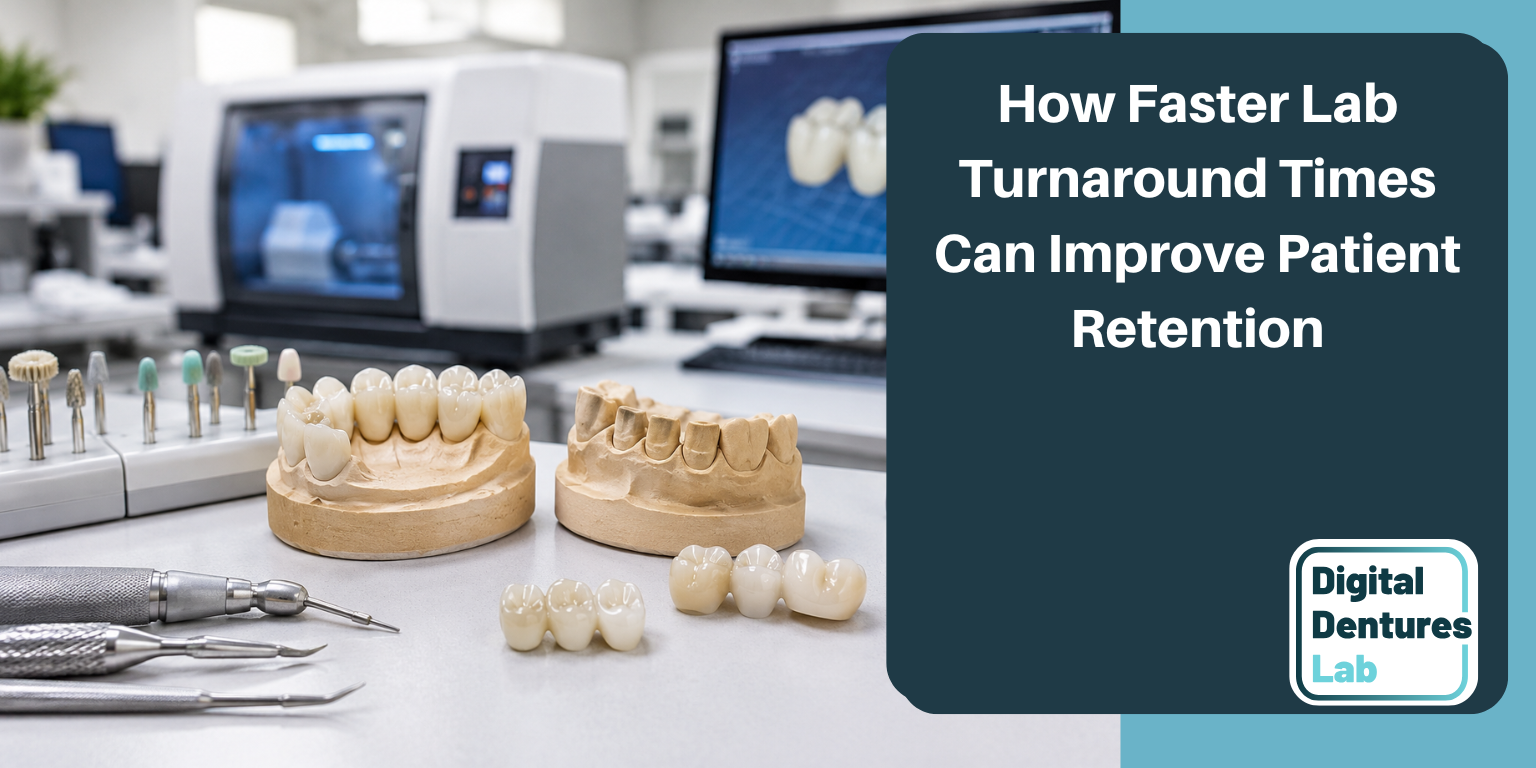



For many dental practices, patient retention problems do not start at the front desk or the treatment plan. They start in the schedule. A denture case that should have been delivered three weeks ago is still in transit. The patient has called twice. The appointment has been rescheduled once. By the time the restoration arrives, the clinical result may be excellent, but the patient's experience of the process has already been shaped by the wait.
Could your lab's turnaround time be affecting patient retention without you realizing it?
Patients do not evaluate dental care only on the quality of the final restoration. They evaluate the entire treatment journey like how long it took, how clearly they were communicated with, and whether the practice felt organized and capable. Faster, reliable dental lab turnaround time can support patient satisfaction, reduce some avoidable scheduling friction, and create a practice environment where restorative cases move forward instead of stalling.
This blog examines how lab performance connects to patient retention, what modern turnaround benchmarks look like, and what practical steps can help practices protect both their schedules and their patient relationships.
Clinical expertise is the foundation of patient trust, but convenience and efficiency shape whether patients stay. Today's patients expect timely care, clear communication, and visible progress. A treatment that stretches across several weeks without explanation creates uncertainty, and uncertainty creates doubt about the practice, about the process, and about whether the outcome will be worth it.
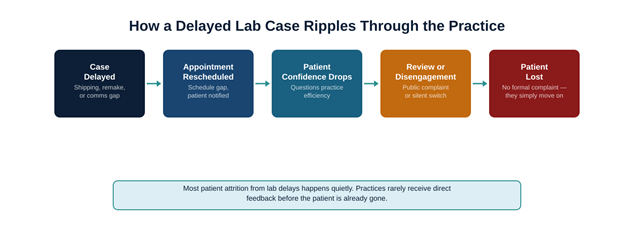
A delayed denture or restoration is not a neutral inconvenience for most patients. It affects eating, speaking, and daily confidence in ways that are visible and frustrating long before delivery. What makes the situation more complicated is that most patients have no visibility into the lab process. They are unaware of shipping timelines, fabrication schedules, or overseas customs delays. From their perspective, they came to your office, submitted to treatment, and the timeline is your responsibility. When delays occur, the practice absorbs the reputational impact regardless of where the breakdown happened.
That dynamic is what connects lab performance directly to patient retention. The lab's turnaround does not just affect one appointment. It shapes the patient's overall impression of whether the practice delivers on its commitments.
The most visible effect of a delayed case is the rescheduled appointment. But the downstream consequences reach further than that. A patient who waits longer than expected for a prosthesis may be more likely to cancel follow-up appointments, hesitate before accepting future treatment recommendations, or express frustration about the process. When patients are unhappy with a restorative experience, they often focus on practical frustrations such as wait times, repeated appointments, or unclear communication, even when the final restoration is clinically acceptable.
For practices managing a steady volume of removable and restorative cases, those effects compound quickly. Each delayed case creates a gap in the schedule, consumes front desk time tracking a case that has not arrived, and occupies chair time on an adjustment visit that could have been avoided with a more accurate first delivery. Over time, that pattern makes scheduling reactive rather than predictable, and it creates the kind of inefficiency that is difficult to trace back to a single source.
Delayed cases also increase the risk of patient disengagement at the exact moment treatment momentum matters most. A patient who is already anxious about wearing a denture, or who has been without teeth during a waiting period, is not in a neutral state when they receive news of another delay. That is when practices lose patients quietly, not through a formal complaint, but through a simple decision to try somewhere else.
The shift to digital denture workflows has changed what dental practices should reasonably expect from a lab partner in terms of speed. Cases that once required two to three weeks through a conventional fabrication process like physical impressions, stone models, manual wax-up, acrylic processing, and international shipping, can now be produced on shorter, more reliable timelines using CAD/CAM design, 3D printing or milling, and direct digital file transfer.
For a busy dental office, faster turnaround is not only about speed. It is about schedule reliability. When the lab process is predictable, the practice can give patients clearer expectations and reduce the disruption caused by cases that arrive later than planned. Clinical workflow literature has described CAD/CAM-supported digital workflows as useful for more prompt prosthesis delivery when time constraints matter, which reflects a practical reality that restorative teams are already working around.
This is especially relevant in removable prosthodontics, where fewer delays and fewer unnecessary appointments can make the treatment process easier for both the patient and the dental team.
Case Type | Traditional / Overseas Lab | USA DIGITAL DENTURE LAB |
3D Printed Dentures | 2 – 4 weeks | 4 business days |
PMMA Milled Dentures | 2 – 4 weeks | 5 business days |
Traditional Dentures | 3 – 5 weeks | 7 business days |
Partial Dentures and Frameworks | 2 – 3 weeks | 4 – 5 business days |
Implant-Supported Restorations | 3 – 6 weeks | 7 business days |
Overseas labs can introduce variables that domestic digital labs may be better positioned to manage or avoid. International shipping, customs clearance, time-zone communication gaps, and the inability to resolve a design question quickly mid-case all extend timelines in ways that are difficult to predict or communicate to patients in advance. A correction that can be addressed quickly by a domestic lab may take longer when the case is routed through an overseas workflow.
The connection between lab turnaround time and practice performance is more direct than it may appear. When treatment plans stay on schedule, the business side of the practice is easier to manage. When cases stall in the lab, the production side of the practice stalls with them. Practices managing a steady volume of full dentures, partial dentures, and implant solutions feel the compound effect of those delays across the month - not as one missed case, but as a pattern that reduces completed case volume, increases adjustment visits, and consumes chair time that could have been used for new production.
When a practice can plan its schedule around reliable lab timelines rather than optimistic estimates, the entire team operates more efficiently. Front desk staff spend less time fielding status calls. Assistants spend less time preparing operatories for deliveries that do not happen. Dentists spend less avoidable time on chairside corrections. That operational efficiency can improve the patient experience. Patients notice when treatment progresses smoothly, and that impression can influence whether they return for future care or refer others.
Faster restorations do not just improve individual cases. They improve the schedule, the patient experience, and the practice's capacity to grow.
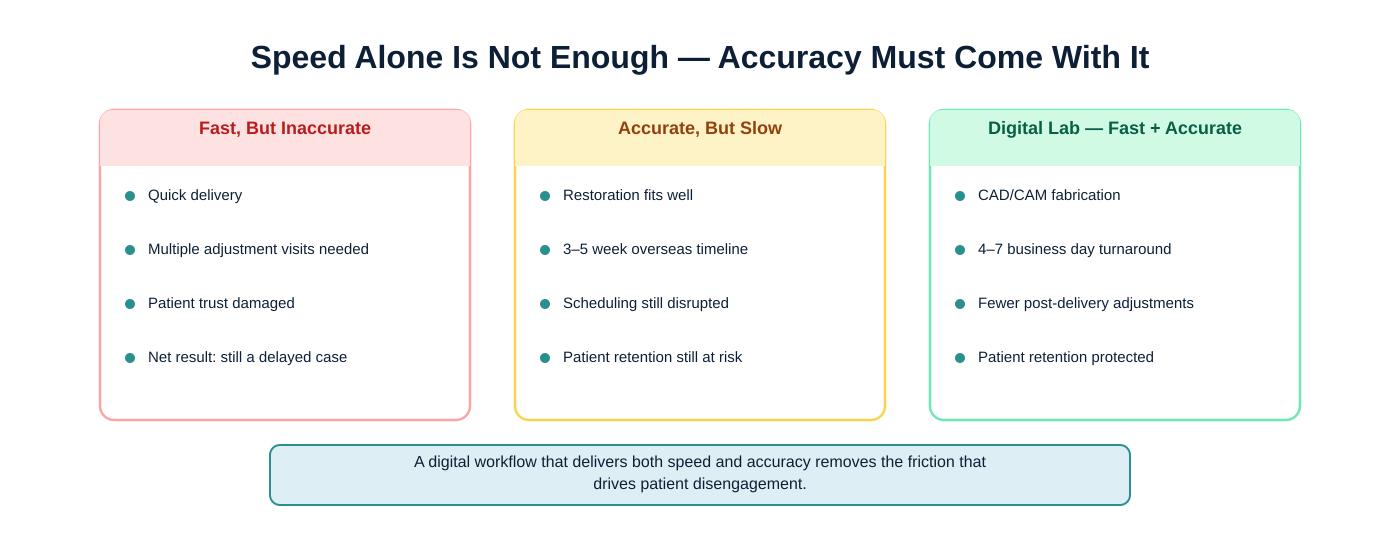
A case that arrives in four days but requires three chairside adjustment appointments is not an efficient case. It is a different kind of delay, one that consumes more chair time, more of the patient's patience, and more of the schedule's capacity than a slower but accurate case would have. Speed and accuracy are not in competition in a well-run digital workflow. A lab that delivers both is the one that actually improves retention.
Remakes and post-delivery adjustments extend treatment timelines in ways that are difficult to explain to patients. Even a minor fit correction signals that something was not right the first time. That signal small as it may seem erodes the clinical confidence that makes patients comfortable returning for future treatment and referring others. Research comparing digitally and conventionally fabricated complete dentures has reported potential advantages related to fewer visits and reduced chair time in digital workflows, which reflects the operational benefit of cases that arrive closer to the intended result from the first delivery.
CAD/CAM design and digital fabrication reduce the manual variables that create inconsistency in conventional workflows. Because a case is designed digitally before production begins, design questions can be identified and resolved before fabrication, not after a try-in or delivery problem reveals them. That combination of reliable timelines and more consistent clinical outcomes is what distinguishes a true digital dental lab service from a conventional lab that has added digital equipment without changing the underlying workflow.
Every restoration that leaves a lab and enters a patient's mouth reflects on the dental practice. Patients do not know the name of the lab. They know their dentist. That means the lab’s turnaround performance, communication reliability, and fabrication consistency can strongly influence what patients experience and how they judge the overall treatment process.
Missed deadlines, slow responses to case questions, and inconsistent quality are not isolated problems. They create a pattern that shows up across the schedule as adjustment visits, remake requests, and rescheduled deliveries. A practice absorbing those inefficiencies will consistently underperform on the metrics that matter most for retention: how often cases are completed as planned, how frequently patients need additional appointments, and how confident patients feel in the process.
Working with a responsive domestic digital lab can change that dynamic. Faster shipping, same-time-zone communication, and a digital workflow that stores case files and supports faster corrections can reduce some of the variables that make outsourced workflows harder to manage. A lab relationship built on consistent turnaround and responsive communication gives the practice the operational stability it needs to make and keep patient commitments.
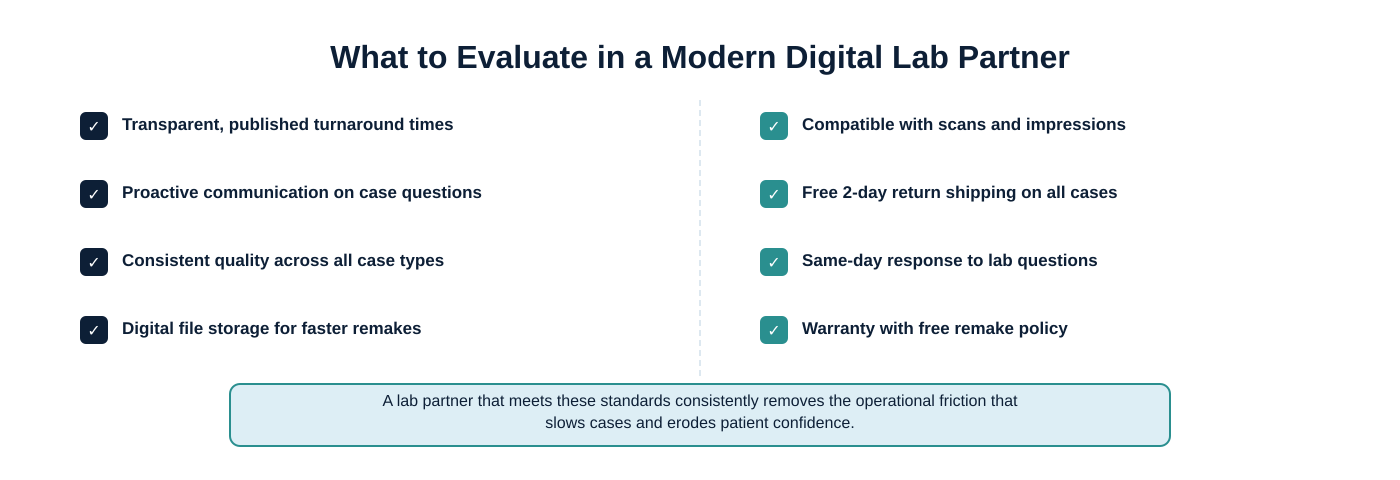
The technology matters, but the partner matters just as much. A digital workflow only improves efficiency when the laboratory behind it has a clear submission process, transparent turnaround standards, responsive communication, and consistent quality control across all case types. Before evaluating a new lab partner, practices should have clear answers to a few core questions: Are turnaround times published and consistently met? How does the lab communicate when a case requires clarification? What is the remake and correction process, and does it require restarting the full production cycle?
Practices that work with a digital denture lab built around those standards will find that the operational benefits such as fewer disruptions, more predictable scheduling, and patients who experience a treatment process that matches their expectations, tend to compound over time. A lab relationship is not a commodity decision. It is a workflow decision that affects every restorative case that moves through the practice.
A practice does not need to overhaul every system at once to see a difference. A practical first step is to evaluate where restorative cases are currently creating scheduling friction. Common warning signs include cases arriving later than the stated turnaround, adjustment visit rates that seem high relative to the case type, difficulty getting timely responses from the lab on case questions, and patients who mention, or do not mention but whose behavior reflects, frustration with how long treatment is taking.
If those patterns are recurring, it may be time to evaluate whether the current lab relationship is built to support the practice's retention goals. A recent cost-efficiency review highlights why time and cost factors are central to the digital-versus-conventional denture discussion, and for practices managing a high volume of removable cases, the operational difference between a predictable domestic digital lab and an unpredictable overseas one is not marginal. It shows up in the schedule, in patient feedback, and in the practice's ability to make and keep the commitments that build long-term loyalty.
Reliable lab turnaround time is one of the most direct ways a dental practice can improve the patient experience without changing its clinical approach. When restorative cases arrive on schedule, fit accurately, and require fewer follow-up visits, patients leave with a stronger impression of the practice, and a stronger reason to return.
Digital Dentures Lab supports dental practices with technology-driven fabrication, transparent turnaround times, free 2-day FedEx shipping, and practical digital dental lab services built around the needs of modern restorative teams. Whether your practice is managing full dentures, partial dentures, implant solutions, or crown and bridge cases, our workflow is designed to keep cases moving and patient timelines on track.
Contact Digital Dentures Lab to learn how our digital denture solutions can help your practice reduce delays, protect patient retention, and deliver restorative cases with greater consistency and reliability.
Long delays can frustrate patients and reduce confidence in the practice. Since patients typically associate delays with their dental office rather than the lab, extended turnaround times may negatively impact retention.
Turnaround times vary by case type, but modern digital workflows and domestic production often allow many restorative cases to be completed within about a week of submission.
Yes, when speed is combined with quality. Faster delivery of accurate restorations can reduce waiting times, limit unnecessary appointments, and improve the overall patient experience.
A reliable lab helps practices maintain predictable treatment timelines, improve patient satisfaction, and support stronger referrals, reviews, and long-term loyalty.
Digital labs streamline workflows through digital file transfers, CAD/CAM fabrication, and improved case communication, helping cases move more efficiently from submission to delivery.

Get updates, case details, and lab innovations to support your practice and patient outcomes.