
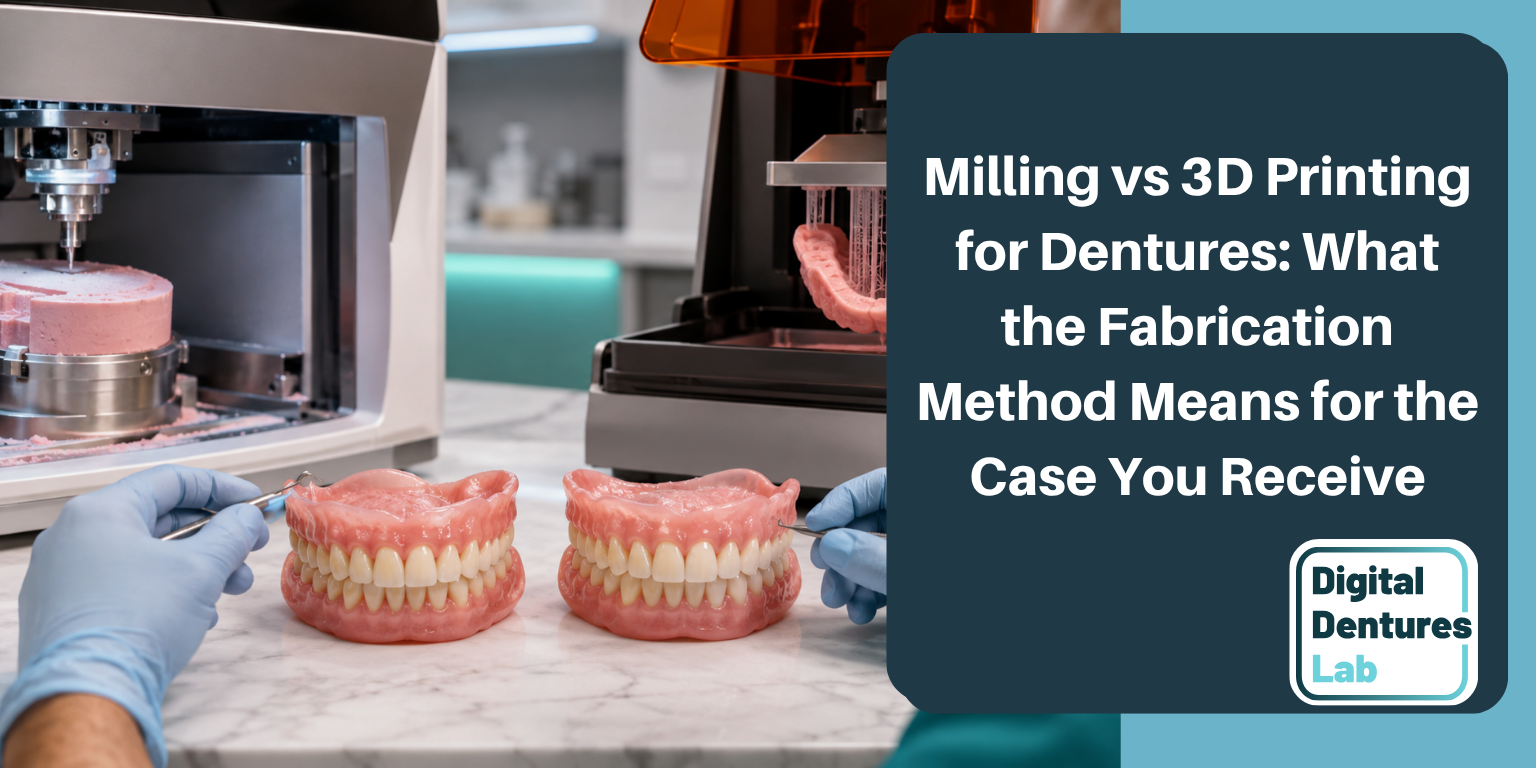



Digital denture design is only the first half of the manufacturing story. Once the CAD file is approved, the laboratory still has to turn that design into a physical restoration, usually by CAD/CAM milling or 3D printing.
The two methods can produce restorations that look similar at delivery, but they create the material differently. Material structure, surface characteristics, dimensional accuracy, post-processing, and mechanical performance can therefore differ. A tooth-position comparison found both methods clinically acceptable for the specific outcomes evaluated, while also showing that precision can vary between fabrication approaches.
For the dentist, the practical question is whether the fabrication method and material suit the case and whether the lab controls the process consistently. Understanding milling vs 3D printing makes it easier to evaluate lab quality, ask better pre-submission questions, and set realistic clinical expectations.
When a practice sends a digital scan or a conventional impression that will be digitized, the laboratory creates or receives a CAD file and combines it with the prescription. The same design data can drive a dental milling machine or a validated 3D-printing workflow. What changes is how the physical restoration is produced from that file.
The choice should reflect the restoration type, material, geometry, functional demands, esthetics, and the lab's equipment and validated processes. Some laboratories offer both methods; others standardize around one. Using one method is not automatically a quality problem. What matters is whether the laboratory can explain why its process is appropriate for the case.
Dentists can ask which method and material will be used before submission or approval, especially when a restoration has high functional demands, unusual geometry, a history of fracture, or a specific material requirement.
In subtractive manufacturing, the CAD file directs a milling unit to remove material from a prefabricated disc or block until the designed form is reached. For denture bases, the material is commonly highly polymerized PMMA. Material is removed rather than added.
Prepolymerized PMMA discs are widely used for complete denture bases and other acrylic removable applications. Milling is especially useful when established PMMA properties, mechanical demand, dimensional stability, or a controlled milling workflow are priorities.
Milling is not restricted to conventional two-piece denture construction. The Ivotion system is one example of a monolithic complete denture produced from a disc that integrates tooth and denture-base materials. Immediate and duplicate dentures can also be produced in validated milling workflows.
Subtractive fabrication produces material waste because burs remove material from a larger blank. Deep undercuts or complex internal geometry may also require design changes, specialized strategies, or another fabrication approach.
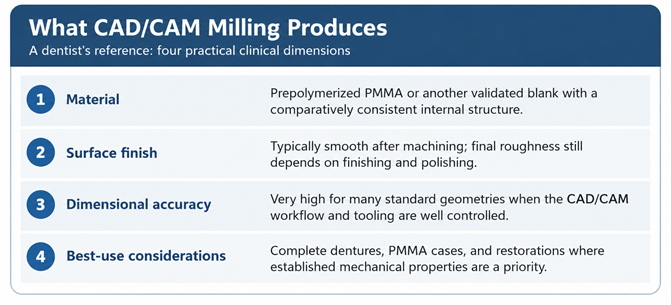
Figure 1. CAD/CAM milling reference: material, surface finish, dimensional accuracy, and best-use considerations.
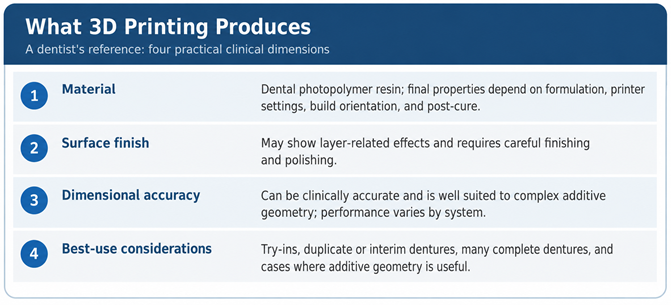
In additive manufacturing, the CAD file is divided into layers and the printer builds the restoration sequentially from a photopolymer resin. The printed object then goes through manufacturer-specified washing, post-curing, support removal, finishing, and polishing before delivery.
Dental 3D printing materials should be identified by manufacturer and intended use. Dentists should not assume that every printable resin is cleared for long-term intraoral use. The Lucitone Digital Print Denture System is one example; its clearance and labeled dental indication are documented in the FDA 510(k) record.
This is where lab transparency matters. Digital Dentures Lab states that it works with dental-grade, biocompatible materials from verified suppliers and can provide available material documentation when a practice asks. Its material guidance also distinguishes FDA clearance from the looser marketing term “FDA approved.”
Printed denture performance depends on more than printer resolution. A recent systematic review found wide variability in mechanical properties across printed materials and identified resin formulation, build orientation, and post-curing as important sources of heterogeneity. Two laboratories can therefore use the same general technology and still produce different results if their material and post-processing protocols differ.
Printing can support monolithic dentures and other consolidated workflows, but monolithic construction is not exclusive to 3D printing. The relevant question is whether the system is validated for the intended indication.
Neither method is universally superior. Laboratory studies often show mechanical or accuracy advantages for milling, while clinical studies show that both methods can produce acceptable complete dentures. A 2025 clinical meta-analysis found no statistically significant difference between milled and printed complete dentures for retention or patient satisfaction, although the evidence base was small and heterogeneous.
Clinical dimension | Milling | 3D printing |
Material structure | Prefabricated, industrially polymerized blank; properties are comparatively consistent within a controlled material system. | Layer-cured resin; properties vary more with formulation, build orientation, printer settings, and post-cure. |
Surface finish | Typically smooth after machining and polishing; final roughness still depends on finishing. | May show layer-related surface effects and requires careful finishing and polishing; quality varies with process. |
Dimensional accuracy | Very high for many conventional geometries; often used as an accuracy benchmark. | Can be clinically accurate and is well suited to complex additive geometry; performance varies by printer, material, orientation, and lab protocol. |
Long-term durability | Mechanical performance is well established for milled PMMA, with strong in-vitro flexural-strength evidence. | Modern resins are improving, but durability varies more by resin generation and processing; long-term clinical evidence is still developing. |
Common case fit | Complete dentures, PMMA cases, and restorations where established mechanical properties are a priority. | Try-ins, duplicate and interim dentures, many complete dentures, and cases where additive geometry or production efficiency is advantageous. |
Accuracy should not be reduced to a simple winner-and-loser statement. A multicenter accuracy study found milling more accurate in most participating centers, but printed try-ins remained within a clinically acceptable range and performance varied by center. That variation reinforces the importance of the laboratory's production controls.
The same caution applies clinically. In one randomized crossover clinical trial, both milled and 3D-printed complete dentures were valid treatment modalities, but the printed group required more maintenance visits and adjustment time. Other reviews report broadly comparable patient satisfaction, so fabrication choice should remain case-specific.
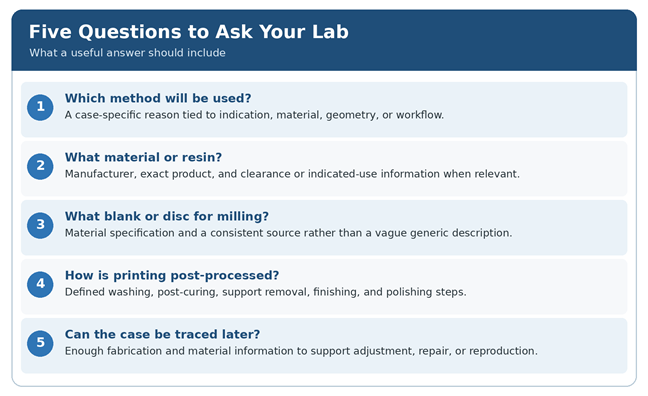
Figure 3. Five fabrication questions and the elements of a specific, useful laboratory answer.
A dentist does not need to manage the laboratory's production floor, but the practice should know enough about fabrication to evaluate the restoration it is prescribing. Five questions are worth asking before the next case goes into production:
1.Which fabrication method will be used for this case type, and why is it appropriate for the indication?
2.For printed cases, what resin is being used, who manufactures it, and is the material FDA-cleared or otherwise legally marketed for this indication?
3.For milled cases, what material disc or block is being used, and is the source consistent from case to case?
4.What washing, post-curing, support removal, finishing, and polishing steps are used for printed restorations before shipment?
5.Can the lab identify the fabrication method and material later if the restoration needs adjustment, repair, duplication, or reproduction?
The goal is specificity, not a particular brand. A useful answer identifies the method, material source, processing steps, and enough case information to support future service or reproduction.
Digital Dentures Lab offers both 3D-printed and PMMA-milled dentures, uses CAD/CAM design, and states that material information can be provided when practices ask. Dentists can use those options to discuss the fabrication approach that best matches the prescription.
Milling shapes a prefabricated material blank; 3D printing builds the restoration from a resin system whose final properties depend strongly on processing. Those differences can affect strength, surface quality, geometric freedom, accuracy, finishing, and long-term expectations.
The better standard is not to declare one method best for every case, but to match a documented material and fabrication process to the clinical requirements. Digital Dentures Lab uses CAD/CAM milling and 3D printing for removable prosthetics, produces restorations in the United States, and includes free 2-day FedEx shipping. Dentists can submit a case or contact the lab before production to discuss the workflow and material.
Milled dentures are cut from a prefabricated disc or block, while 3D printed dentures are built layer by layer from resin and then post-processed. The difference affects material structure, finishing, mechanical behavior, and manufacturing geometry.
Modern printed denture resins can be clinically useful, but in-vitro reviews generally show stronger mechanical properties for milled PMMA. Clinically, both methods can produce acceptable complete dentures, and retention or patient satisfaction may be similar.
Milled complete denture bases commonly use industrially polymerized PMMA discs. Some systems also combine tooth and base materials in a monolithic milling disc. The exact material depends on the lab, restoration design, and manufacturing system.
A practice can ask which method the lab plans to use and whether an alternative is appropriate. The final choice should consider the case indication, material requirements, geometry, functional load, and the lab's production workflow rather than preference alone.
It can contribute, because material properties and processing influence strength, surface quality, and wear behavior. Longevity also depends on occlusion, fit, patient habits, maintenance, cleaning, tissue changes, repairs, and the clinical records used to fabricate the denture.

Get updates, case details, and lab innovations to support your practice and patient outcomes.