


Nightguard and splint cases are usually straightforward lab submissions, but important details can be easy to overlook. A case labeled simply “nightguard” may leave questions about the appliance type, arch, material, thickness, bite relationship, and clinical objective.
A predictable result still depends on complete records. An accurate interocclusal record, scans or impressions of both arches, the intended arch, and clear design instructions matter. In a digital dental workflow, those records guide CAD design and fabrication, so missing information can delay production.
The goal is simple: give the lab enough information to fabricate the prescribed appliance. Here is what a digital lab needs and what to look for in a reliable dental laboratory handling nightguards, occlusal splints, and sports mouthguards.
“Nightguard” is often used as a catch-all term, but not every protective or occlusal appliance serves the same purpose. A bruxism nightguard is generally prescribed to protect teeth and restorations from the effects of grinding or clenching. An occlusal splint may be prescribed as part of a broader plan for occlusal therapy or management of temporomandibular disorder (TMD) symptoms. A sports mouthguard is designed for impact protection during athletic activity.
Those distinctions matter to the laboratory because the clinical purpose influences design, coverage, material selection, thickness, and occlusal scheme. The NIDCR TMD guidance also emphasizes that intraoral appliances used for TMD should not be intended to permanently change the bite. The dentist therefore needs to define the therapeutic objective rather than leaving the laboratory to infer it.
Sports mouthguards are a separate category of protective appliance. The ADA mouthguard guidance recommends properly fitted mouthguards for activities with a meaningful risk of dental or orofacial injury. A sports guard should therefore be submitted with its protective purpose clearly identified rather than treated as an interchangeable version of a bruxism appliance.
A generic “nightguard” prescription can leave the laboratory guessing about the intended design. Specify the appliance type first.
A complete submission should be understandable without a follow-up call or email. At minimum, the lab needs accurate records of both arches, a usable bite registration, the intended appliance arch, and a clear statement of clinical intent.
Digital Dentures Lab accepts intraoral scans or traditional impressions, so practices can use the capture method that fits their workflow. Conventional impressions still need to reproduce the relevant anatomy cleanly enough for the lab to digitize and design from them.
Material and thickness preferences should be stated rather than assumed. A bruxism guard, an occlusal splint, and a sports guard may call for different properties and dimensions even when the fabrication sequence is similar. If the case requires a flat plane, canine guidance, group function, or another specific occlusal scheme, that instruction should come from the prescribing dentist. The laboratory can execute the design; it should not make the clinical decision.
Complete records at intake help prevent avoidable clarification delays before CAD design begins.
Complete instructions support dental practice efficiency by allowing the lab to move from intake to design without stopping for clarification.
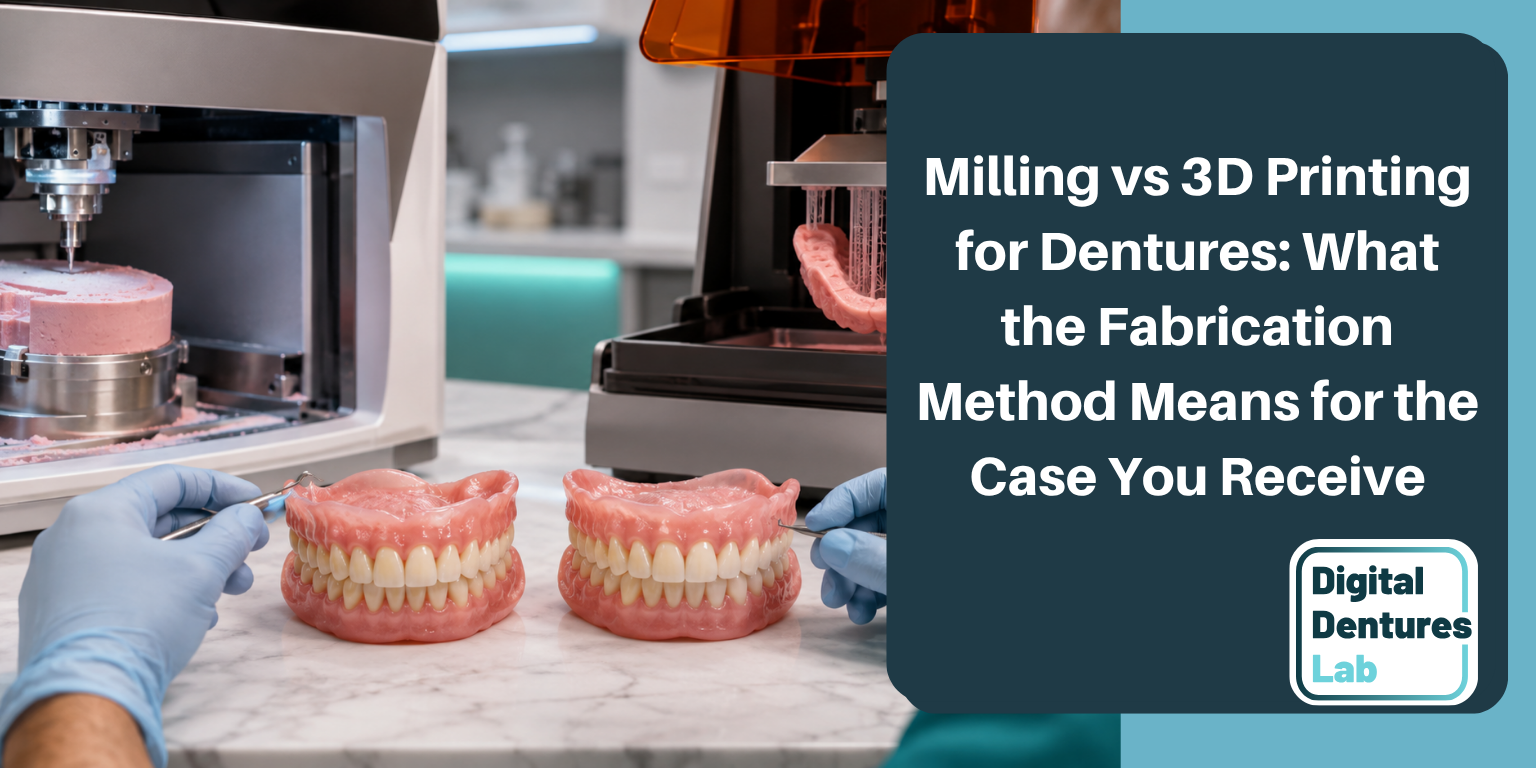
Digital nightguards and splints may be produced through additive manufacturing (3D printing) or subtractive CAD/CAM milling. In both workflows, the appliance is designed digitally from the submitted records; the difference is how the physical appliance is produced.
A 3D-printed appliance is built layer by layer from dental resin; a milled appliance is cut from a prefabricated blank or disc. Manufacturing method can influence material structure, finishing, surface characteristics, and geometry. A systematic review comparing resins used for occlusal devices found meaningful differences in mechanical properties among printed, milled, and conventionally processed materials. The material and method should therefore match the prescribed appliance rather than treating every guard as equivalent.
The practical question is not simply “printed or milled?” but why one method fits the case. Ask what material is used, how the design is reviewed, which thickness options are available, and how the method fits the clinical purpose. A recent CAD/CAM workflow report describes an all-digital stabilization-appliance process using intraoral scans, CAD design, and CAM milling, showing how the record, design, and manufacturing stages connect.
The fabrication method is only one part of the decision; material selection, design intent, and case records still determine how the appliance should be prescribed and produced.
Nightguard and splint cases may require additional adjustment or refabrication when the records do not accurately describe the patient’s anatomy, occlusion, or prescribed design.
An inaccurate or incomplete bite registration can create an occlusal discrepancy in the designed appliance. Incomplete scans or distorted impressions can affect adaptation. A prescription that does not identify the arch can stop the case at intake. And a submission that says only “nightguard” may leave the technician without enough information to know whether the dentist intends bruxism protection, a therapeutic occlusal splint, or a sports appliance.
A defined intake review should catch missing records or unclear instructions before fabrication, when the practice can clarify them without creating a problem after delivery.
A structured intake check protects the workflow by catching missing information before manufacturing begins.
A dependable dental lab for dentists should accept the records the practice can reliably capture, provide a clear design-review step before manufacturing, and publish pricing for this case type.
Digital Dentures Lab accepts digital scans and traditional impressions for splint and guard cases, with online design approval before fabrication. It publishes $119 for 3D-printed nightguards and $169 for milled nightguards, plus free two-day FedEx shipping.
For a practice comparing laboratories, transparency matters. You should know what the lab needs, how the case will be designed, which manufacturing options are available, and what the published price includes. Clear expectations reduce back-and-forth and support a more efficient practice-lab workflow.
A clear submission and approval process keeps the practice and laboratory aligned before manufacturing starts.
Routine or not, a nightguard or splint case depends on accurate records, a clear prescription, and communication about the intended result. Specifying the appliance type, arch, material or thickness preference, bite relationship, and design requirements lets the laboratory execute the case instead of filling in gaps.
Digital Dentures Lab supports that process with 3D-printed and milled nightguard options, published pricing, online design approval, and free two-day FedEx shipping. To discuss a case or submit your next nightguard or splint, contact Digital Dentures Lab.
The lab should receive records of both arches, an accurate bite registration, the intended appliance arch, the clinical purpose, and any material, thickness, or occlusal-design instructions. Complete records allow the technician to design the appliance without guessing at details that should come from the prescribing dentist.
A nightguard is generally prescribed to protect teeth and restorations from grinding or clenching. An occlusal splint may be used as part of dentist-directed occlusal therapy or TMD management. A sports mouthguard is designed for impact protection during athletic activity. Because the purposes differ, the material, thickness, coverage, and occlusal design may differ as well.
Both methods can be used for digitally designed appliances. The better choice depends on the prescribed appliance, material properties, thickness and design requirements, and the laboratory’s validated manufacturing protocol. Dentists should ask which method the lab uses for the specific guard type and why.
Several factors can contribute, including an incomplete scan or distorted impression, an inaccurate bite record, unclear arch selection, or instructions that do not fully describe the intended appliance. A remake should be evaluated case by case rather than attributed to a single cause.
That depends on the laboratory. Digital Dentures Lab states that it accepts both intraoral scans and traditional impressions for splint and guard cases, allowing practices to use the record-capture method that fits their current workflow.

Get updates, case details, and lab innovations to support your practice and patient outcomes.