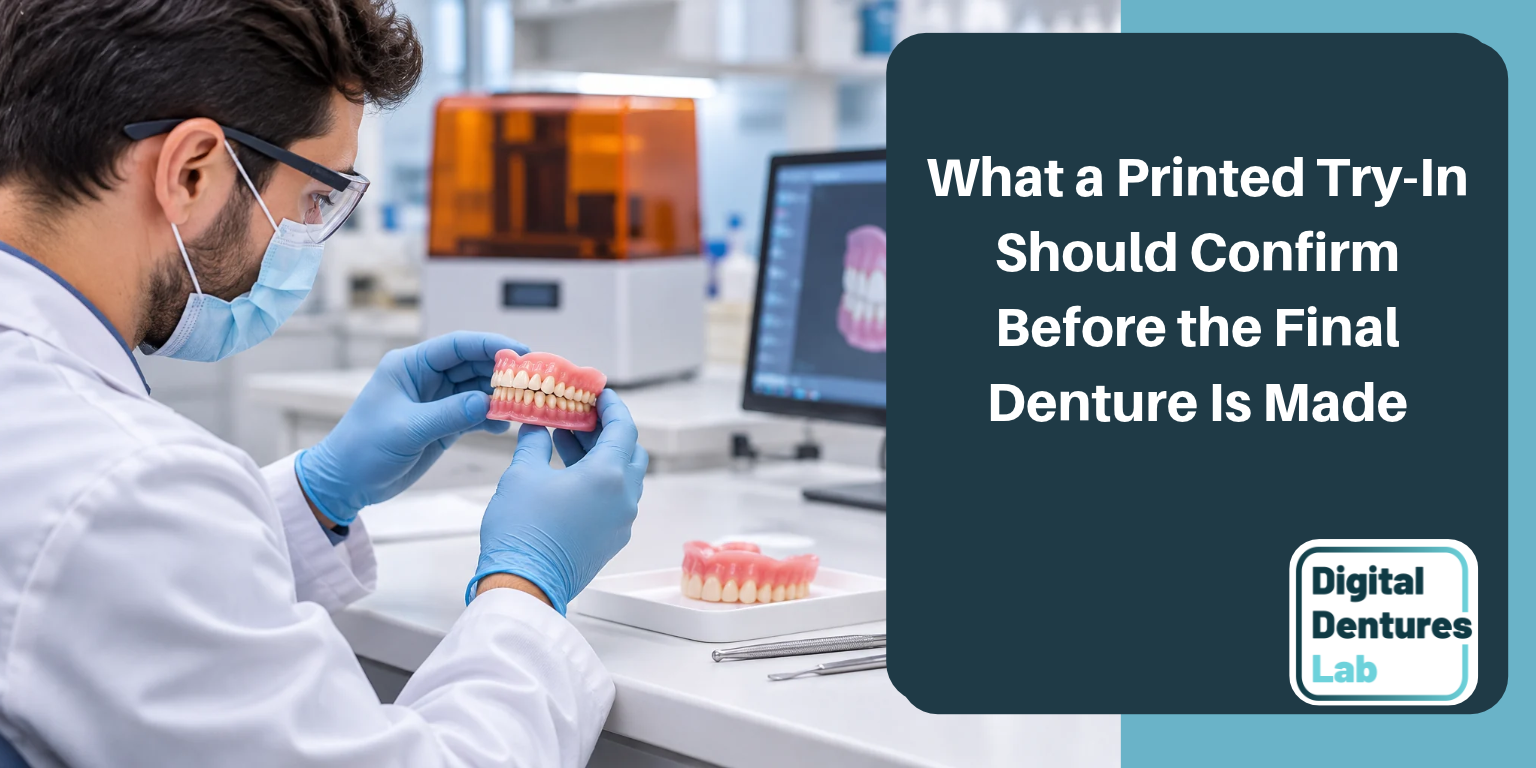



The try-in denture appointment is the last practical opportunity to change tooth position, vertical dimension, and the appearance of the planned denture before the definitive prosthesis is made. That matters in conventional cases and in 3D printed dentures: the final result is manufactured from the design the dentist approves. A digital preview is useful, but it does not replace seeing the arrangement in the patient’s mouth.
For many practices, a printed try-in is the first shared physical reference for the dentist, patient, and lab. The appointment should do more than produce a quick smile approval. Use the following seven confirmations - function first, esthetics next, documentation last - to decide whether the case is ready to move ahead.
The purpose does not change. Both formats allow the dentist to reassess jaw relationships, tooth position, appearance, and speech while the patient can still give useful feedback. Both need an orderly clinical assessment and a clear laboratory response. The material is simply a different way to represent the proposed arrangement.
A conventional wax setup permits teeth to be moved and reset directly in wax, although its baseplate may not reproduce the retention and adaptation of the processed final denture. A rigid printed trial is created from the digital design and, depending on the system and the try-in design, may permit a more meaningful check of base seating or a new interocclusal record. But it is not as convenient to reshape chairside; changes typically go back to the CAD file. Its fit is still provisional and should not be treated as proof of final retention.
The distinction is particularly relevant when the denture base and borders need correction. A clinical trial found border-related adaptation differences between digital and conventional complete dentures at insertion, even though the differences could be managed. Inspect the actual trial rather than assuming a digitally produced base is automatically accurate.
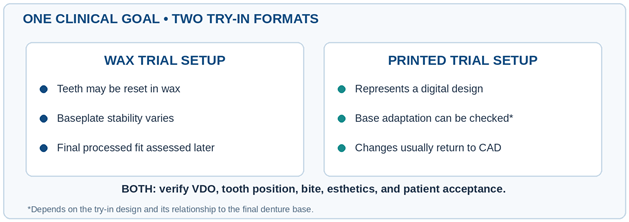
Wax and printed trials share the same clinical purpose; corrections are made differently.
Begin with fit and VDO, then examine tooth position, occlusion, speech, and the patient’s response before documenting approval. The bullseye below groups these checks by clinical priority - function, esthetics/phonetics, and documentation. Use the numbered section headings below for the detailed chairside sequence.
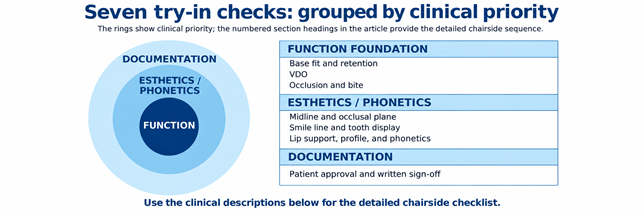
The bullseye groups the seven checks by clinical priority; use the section headings below for the detailed sequence.
Confirm: Seat the trial fully. Check stability, extension, border clearance, soft tissue support, and whether pressure points or rocking occur with speaking and gentle function.
Why it matters: A poorly supported trial makes occlusal and esthetic observations less trustworthy. Even when the printed base reflects the CAD design, its behavior may differ from the final material and processing method.
If it is off: Identify the area and nature of the problem. Tell the lab whether the design can be changed from existing records or whether a new scan, impression, border record, or clinical adjustment is needed.
Confirm: Compare the VDO with established jaw-relation records, prior dentures where relevant, freeway space, facial appearance, comfort, and the patient’s speech and function.
Why it matters: A setup that is too open or too closed can disturb facial proportions, phonetics, and the planned occlusion. A pleasing smile alone does not establish the correct jaw relationship.
If it is off: Document the direction and approximate amount of change; record a new jaw relation if the existing one is not dependable. Do not ask the lab to infer VDO from appearance alone.
Confirm: Check upper and lower dental midlines against each other and the patient’s facial landmarks. Assess the occlusal plane relative to the interpupillary line and facial reference planes, allowing for facial asymmetry.
Why it matters: Small discrepancies may be obvious to a patient in a photograph but hard to communicate from a laboratory cast. They can also affect the apparent tooth display on smiling.
If it is off: Mark the requested location and send frontal photos taken with the patient upright. Describe the direction of the correction rather than simply writing “center the teeth.”
Confirm: Look at incisal display at rest and during speech, the full-smile line, gingival exposure, tooth height, and the size, shape, and shade of the anterior teeth.
Why it matters: Excessive or inadequate display can reflect tooth position, lip support, or VDO - not only tooth selection. There is no single millimeter target that suits every face or smile.
If it is off: Provide a frontal smile image and specify which teeth should be lengthened, shortened, repositioned, or changed in shade or form. Recheck the VDO if the discrepancy suggests a jaw-relation problem.
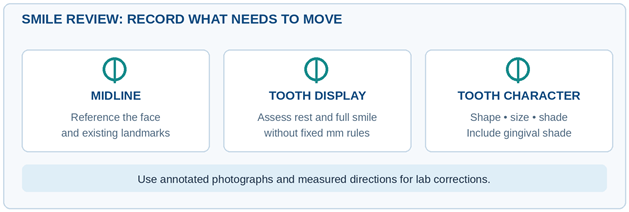
Record the visible landmarks and tooth characteristics that should change.
Confirm: Check centric contacts and the prescribed occlusal scheme. Evaluate whether posterior contacts are appropriate, whether anterior teeth are held open by an interference, and whether overbite and overjet suit the jaw relationship.
Why it matters: The lab can set contacts on an articulator or digital model, but the patient may reveal a discrepancy when the trial is seated and the jaw relation is tested.
If it is off: Record a check bite if indicated. Identify the interfering region and the desired correction, and send new interocclusal records when the existing mounting is unreliable.
Confirm: View the patient from the front and side, watching for excessive flange prominence or inadequate lip support. Ask the patient to say familiar words, including sibilant and “f/v” sounds, in natural conversation.
Why it matters: A lisp, whistle, or altered facial profile may reflect anterior tooth position, contour, or VDO. The cause should be assessed clinically rather than assigned to one feature automatically.
If it is off: Tell the lab which teeth or surfaces need to move, in what direction, and by approximately how much. Annotated profile photos are often more useful than “looks too full.”
Confirm: Ask the patient to look in a mirror and comment on tooth appearance, shade, and the smile; a trusted family member may offer input if the patient wants it. Record the patient’s response and the dentist’s clinical decision in the chart. Document approval in writing and retain dated photographs when indicated.
Why it matters: Design approval is the authorization to proceed toward the definitive denture. A verbal “looks fine” does not show the lab which version was accepted or which concerns remain.
If it is off: Do not sign off on unresolved changes. Send a written correction list and request a repeat try-in when the extent of revision makes direct progression unwise.
A useful revision request identifies a finding and an action. “Raise the maxillary incisal edge about 1 mm” is more actionable than “improve the smile.” “Move the upper midline approximately 1 mm to the patient’s right” is clearer than “straighten the front teeth.” Use measurements only when you can support them clinically; otherwise describe the desired direction and attach marked photos.
Update the prescription with any tooth-size, shape, and shade changes, including preferred gingival shade when relevant. Keep a copy of the check bite and revised photographs with the case record. If multiple adjustments affect VDO, tooth arrangement, and occlusion together, consider another physical try-in rather than approving several changes sight unseen.
If the trial is acceptable, say so explicitly: the dentist approves the listed design and has no further requested changes. That simple written sign-off helps the laboratory distinguish authorization from an unanswered review message. A systematic review of digital complete denture workflows continues to recommend the trial-denture stage to optimize definitive treatment, even though not every reported digital workflow uses one.
Before starting the case, ask whether a try-in is included or optional, what form it takes, whether the base can be used for a check bite, how to send changes, and how a second try-in is handled. The need for a physical verification appointment is a clinical decision based on the quality of the records, planned changes, and patient-specific esthetic or functional concerns.
Digital Dentures Lab offers 3D-printed and PMMA-milled full dentures and lists printed and milled try-ins among its digital services. It accepts intraoral scans and conventional impressions and provides digital design previews for dentist approval. The particular try-in arrangement for a case should still be confirmed with the lab rather than assumed to be part of every package.
For a wider view of manufacturing, see Digital Dentures Lab’s discussion of milling versus printing and its article on digital denture fabrication. Those explain how the approved design becomes the finished appliance. A complete-denture try-in focuses on whether that design should be approved in the first place.
A good try-in denture visit is not just a preview. It is a systematic check of fit and jaw relations, tooth arrangement and speech, and the patient’s acceptance. When the dentist sends specific corrections—or an unambiguous written approval - the lab can work from a design the practice has actually verified.
Review Digital Dentures Lab’s Full Dentures options and complete its denture prescription form for your next case. Ask the Boise-based team how a physical try-in and any follow-up review fit the prescribed workflow before you authorize final fabrication.
It is a provisional physical arrangement used to verify tooth position, jaw relationships, occlusion, appearance, and patient acceptance before the definitive denture is fabricated.
A wax setup allows chairside tooth resetting in wax. A printed trial represents a CAD design more directly; corrections are usually made in the digital file. The clinical checks remain substantially the same.
Minor selective adjustments or a check-bite record may be possible depending on the printed material and design. Major tooth-position or base revisions should be documented for the laboratory rather than improvised chairside.
There is no universal number. One may be sufficient when records and setup are reliable; another is sensible when VDO, esthetics, occlusion, or base fit have changed substantially.
Digital accuracy does not establish that the chosen VDO, tooth arrangement, phonetics, or esthetics are right for the patient. Decide whether a physical try-in is needed from the clinical risk and completeness of records, not the fabrication method alone.

Get updates, case details, and lab innovations to support your practice and patient outcomes.