


Do you know exactly what materials your dental lab is using to fabricate your patients' restorations?
For many dental practices, the answer is less clear than it should be. As digital workflows, offshore outsourcing, and new fabrication technologies have expanded the options available to labs, the variation in material sourcing and safety standards has expanded along with them. Not all materials are equal - and not all labs are transparent about what they are actually using.
Material safety is not a niche concern. It touches patient health, professional liability, practice reputation, and the trust patients place in their dentist when they agree to treatment.
This guide covers what FDA clearance and compliance mean for dental restoration materials, how different materials are classified, where overseas lab outsourcing can create material-verification risk, and what questions every dentist should be asking their laboratory.
When a restoration is placed in a patient's mouth, the lab that fabricated it is not in the room. The dentist is. And from a legal and ethical standpoint, the dentist is accountable for the materials used regardless of where they were made or who sourced them.
Patients trust their dentist to ensure that everything placed in their mouth meets appropriate safety and biocompatibility standards. That trust creates an obligation. If a patient has an adverse reaction to a non-compliant material, the first conversation usually happens in the dentist’s office because the dentist is the provider who recommended, delivered, and documented the restoration.
Patient awareness around this issue is growing. More patients are asking questions about restoration materials, allergies, and what is biocompatible. Practices that cannot answer those questions clearly - or whose lab partners cannot provide documentation - are in a weaker position than those who have verified their supply chain.
Insurance implications are also worth considering. Using materials that fall outside established safety standards can create coverage complications if an adverse event occurs. Documentation of material compliance is not just good clinical practice - it is a practical layer of professional protection.
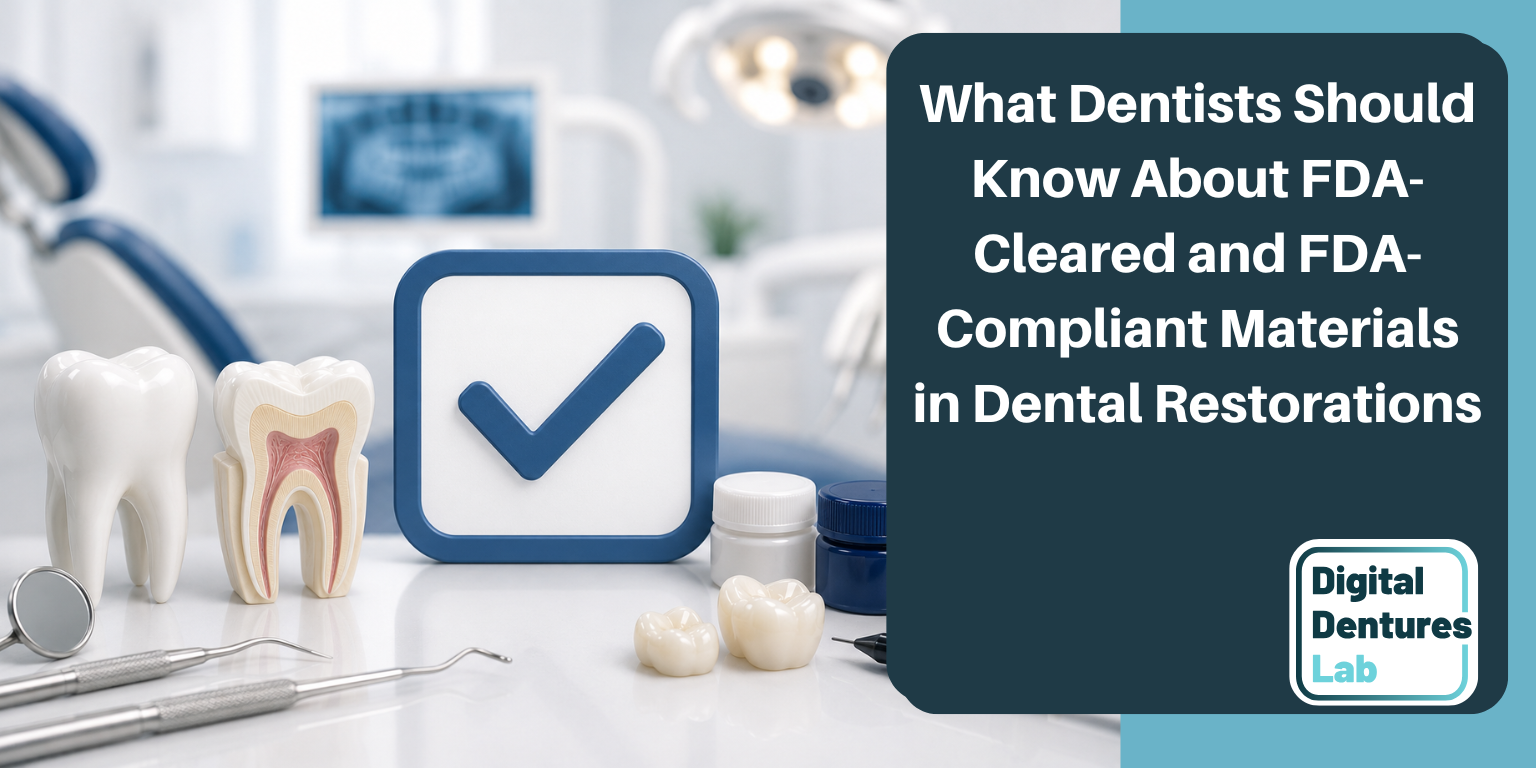
The term 'FDA-approved' is often used loosely. In dental materials, the distinction between approved and cleared matters.
Most dental restoration materials fall under Class II. The 510(k) clearance pathway means that a manufacturer has demonstrated to the FDA that their material is substantially equivalent in safety and performance to a legally marketed predicate device. Biocompatibility testing evaluates whether a material is safe for contact with living tissue - including cytotoxicity testing, sensitization testing, and assessment of systemic toxicity risk.
FDA clearance is not just a label. It is evidence that a material has been assessed against a defined safety and performance standard. For dentists, it is the baseline expectation that should apply to every restoration leaving a lab and entering a patient's mouth.
Understanding the regulatory status of the specific materials used in dental restorations helps dentists ask better questions and catch potential issues before they become clinical problems.
* Cleared when using brand-compliant processes only.
When restorations are sourced from overseas dental labs, material verification can become more difficult for U.S. dental practices. Documentation may be incomplete, supplier information may be harder to confirm, and the materials used may not always be clearly identified as FDA-cleared, dental-grade, or appropriate for the intended clinical use. For that reason, dentists should not assume that an imported restoration was fabricated with compliant materials unless the lab can provide clear, verifiable documentation.
This creates a real gap. Materials sourced from unregulated suppliers may look identical to compliant alternatives. They may even arrive with documentation that is difficult to verify. But without confirmed sourcing from FDA-registered suppliers, there is no documented assurance of biocompatibility or performance standards.
The clinical consequences of non-compliant materials range from minor soft tissue irritation or discoloration to serious allergic reactions or material failures that require full case remakes. Communication barriers make these situations harder to resolve.
Questions Every Dentist Should Ask Their Dental Lab
A reputable lab will answer these questions directly and without hesitation. Vague responses, reluctance to provide documentation, or an inability to identify material sources are meaningful signals.
For U.S. dental practices, working with a domestic lab can make material questions easier to manage. It is usually simpler to ask where a material came from, request documentation, and resolve concerns when the lab is operating in the same country and working with familiar suppliers. That added transparency helps dentists feel more confident that the restorations they deliver are made with appropriate dental-grade materials.
A fully digital domestic lab adds further traceability. Digital workflows allow material lot numbers to be tracked from sourcing through finished restoration. This level of documentation is difficult to replicate in manual or offshore workflows.
Quality control checkpoints at multiple stages of production - design review, post-fabrication inspection, and pre-shipment evaluation - provide additional layers of verification before a restoration reaches the dental practice. Warranty policies and free remake commitments reflect confidence not just in craftsmanship but in the underlying materials.
Direct communication also matters. When a case requires clarification, a material question needs to be answered, or an issue needs to be resolved, working with a domestic lab in the same time zone and language eliminates the delays and miscommunications that create risk in overseas workflows.
Not necessarily. Dentists should verify that their laboratory sources materials from compliant manufacturers and can provide supporting documentation when requested.
Ask for material documentation, supplier information, and material specification sheets. A reputable lab should be able to provide these details upon request.
FDA approval and FDA clearance are different regulatory pathways. Most dental restoration materials are FDA-cleared through the 510(k) process, which confirms safety and performance for their intended use.
Dentists should ask what specific materials are being used, who manufactures them, and whether the lab can provide supporting documentation. When a restoration is coming from outside the U.S., it is especially important to confirm that the materials are appropriate for dental use and that the documentation is clear enough to keep in the patient or practice record.
Zirconia, medical-grade titanium, dental-grade PMMA, and FDA-cleared acrylic resins are widely recognized for their biocompatibility when sourced from compliant manufacturers.

Get updates, case details, and lab innovations to support your practice and patient outcomes.