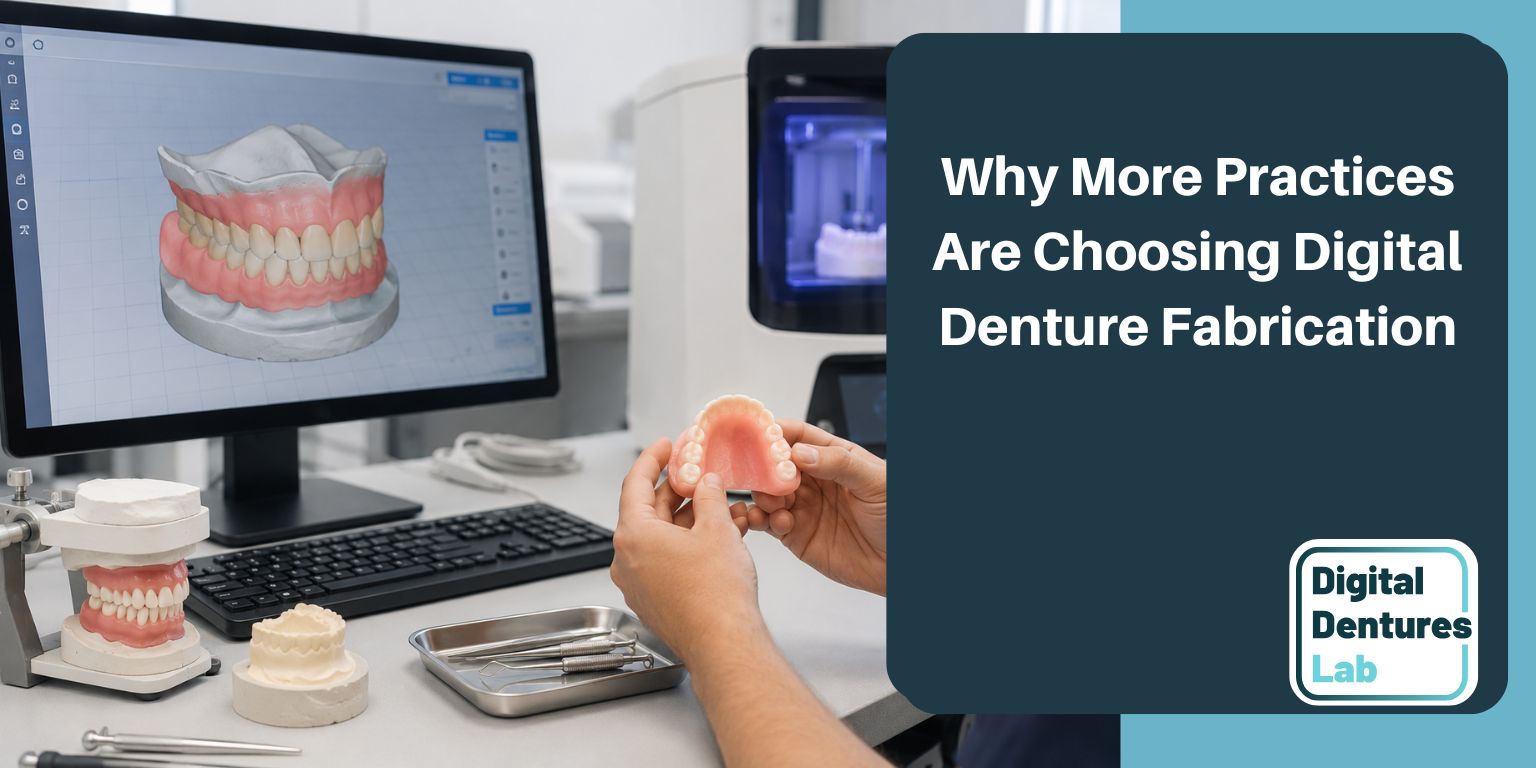



More practices are adopting a digital denture workflow built on scanning and CAD design. A digital workflow is file-based: instead of moving physical models through every stage, it can reduce selected physical handoffs and support more standardized production, often alongside the conventional methods a practice already uses. For a lab like Digital Dentures Lab, that approach comes with U.S.-based production, documented materials, and a published 3 to 5 business-day turnaround for many case types.
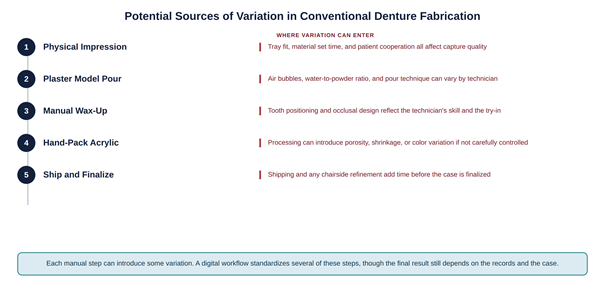
Conventional denture fabrication has evolved over the years, but it remains a largely hands-on process. A dentist takes a physical impression, the lab pours a plaster cast, and a technician builds a wax-up. At the wax try-in, the dentist evaluates esthetics, phonetics, vertical dimension, and jaw relations, then sends any changes back to the lab, which packs and cures the acrylic to finish the denture. Each step relies on skilled human judgment, and the number of manual handoffs leaves more room for case-to-case variation than a file-based digital workflow does.
Depending on the lab, technician, and materials, a conventional workflow can involve a longer timeline and more variation from case to case. None of this makes traditional fabrication wrong. It has produced well-fitting, serviceable dentures for generations. It is simply less standardized than a digital workflow, which is where many practices now see room to gain time and consistency.
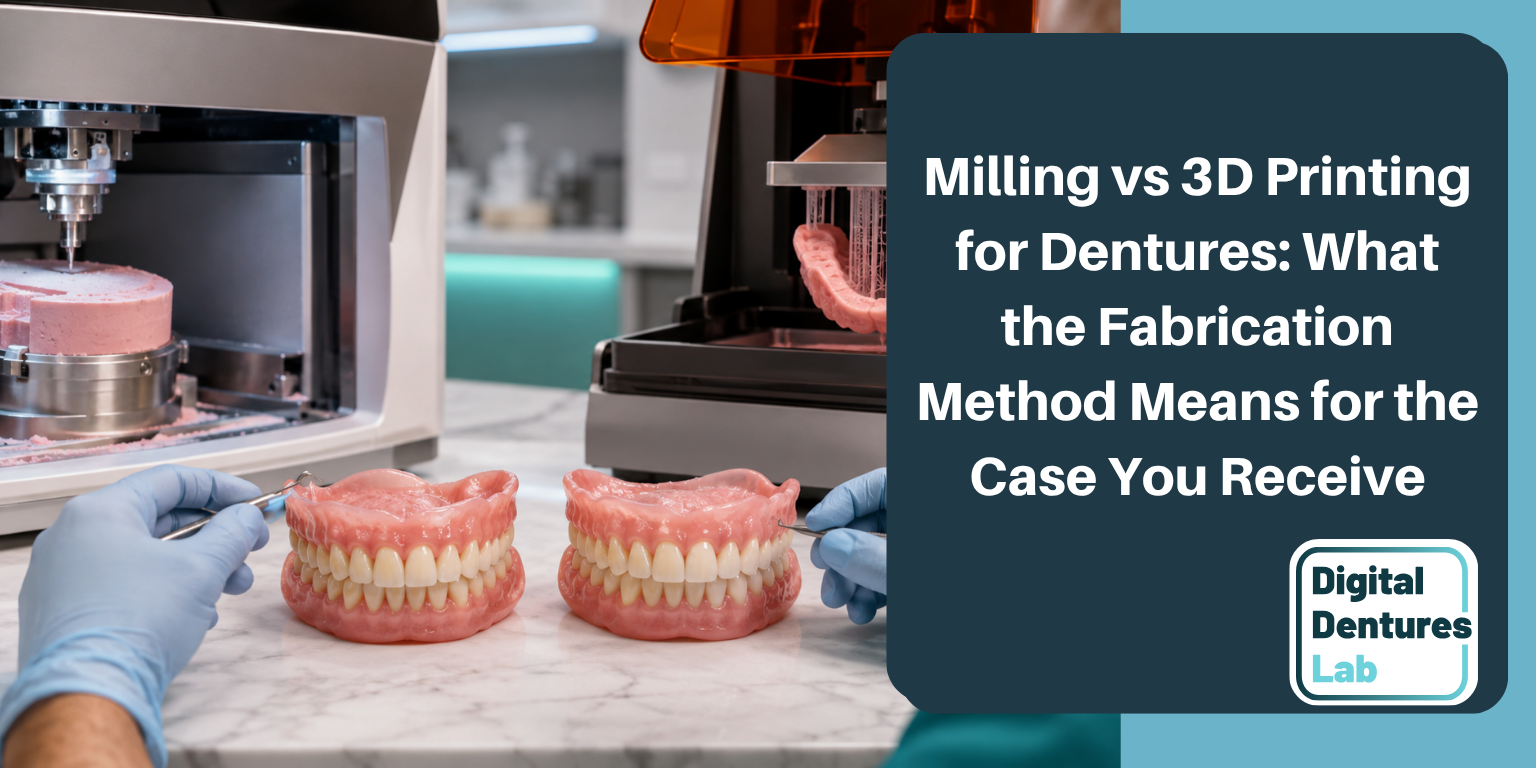
A digital denture workflow starts with a digital file. The practice either captures an intraoral scan or takes a conventional impression that is then digitized, and sends that file directly to the lab. A technician designs the restoration in CAD software, positioning teeth and shaping the base with a high level of digital control and repeatability. A systematic review of digital complete dentures reports that CAD/CAM adaptation is generally acceptable, while accuracy still varies by technique and system. Once the design is approved, CAD/CAM milling or 3D printing produces the physical restoration using the FDA-cleared, biocompatible materials Digital Dentures Lab sources and documents. The process moves from digital impressions for complete dentures to a finished prosthesis without most of the manual handoffs traditional fabrication requires. For a dentist evaluating a lab partner, the technology matters less than the outcome: a more consistent, better-documented path from scan to delivery.
The shift comes down to six practical differences that affect nearly every case a practice sends to the lab.
Factor | Traditional fabrication | Digital denture fabrication |
Precision and fit | Depends on manual wax-up and hand adjustment | CAD/CAM design targets a repeatable specification; final fit still depends on the records, jaw relations, design, processing, finishing, and quality control |
Turnaround | Varies by lab and case type; conventional cases can take longer | Digital Dentures Lab publishes a 3 to 5 business-day turnaround for many case types |
Consistency | Depends on the technician, materials, and workflow | Follows a standardized digital design process; consistency also depends on the records and case |
Material quality | Material quality depends on the lab's sourcing and handling | DDL uses biocompatible materials with documented sourcing; individual products can be verified in the FDA 510(k) database. |
Remakes | Remakes can mean added chairside adjustments and follow-up visits | Digital records and standardized steps may reduce some avoidable fabrication variation; remakes still depend on the records and case |
Case storage and retrieval | Physical models must be stored and can be lost or damaged | Digital case files can support a replacement or redesign; tissue or anatomical changes may call for new records rather than an unchanged remake |
Individually, each difference is manageable. Together, they help explain why more practices are choosing digital fabrication.
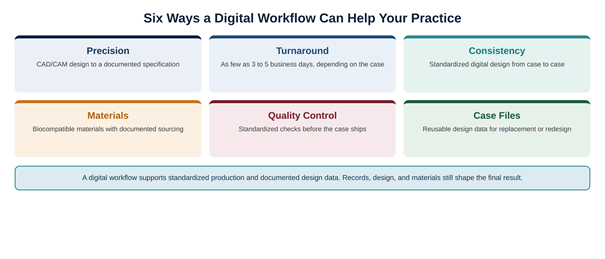
For the practice itself, a digital workflow can change day-to-day operations. A published turnaround can make scheduling more predictable between visits. Reusable digital case data and more standardized production can simplify repeat and replacement cases, and clearer, same-time-zone communication with the lab can make it easier to resolve a design question before a case is produced. These are workflow gains; clinical fit still depends on the records and the individual case.
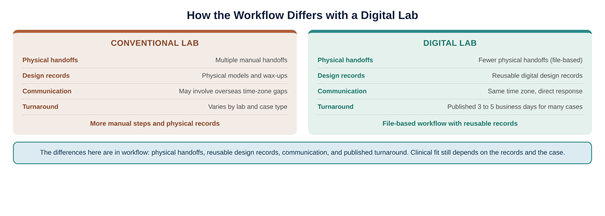
Where a lab operates still matters. Digital Dentures Lab produces cases in the United States, with Boise-based support a practice can reach directly when a design question comes up. DDL includes free 2-day FedEx shipping and publishes a 3 to 5 business-day turnaround for many case types, so a practice knows what to expect. Working with a domestic digital lab also keeps design questions in the same time zone and avoids an international handoff.
Digital denture fabrication is now an established option, valued for the turnaround, consistency, and communication a digital workflow can offer. For many, the question is less whether to explore digital and more how to choose the right lab partner.
Digital Dentures Lab supports practices with CAD/CAM design, 3D printing, FDA-cleared materials, and a digital denture workflow, with restorations produced in the United States. Contact us to discuss case submission, published turnaround, material documentation, and domestic laboratory support.
Digital dentures are designed in CAD software from a digital file, either an intraoral scan or a conventional impression that has been digitized, then produced through CAD/CAM milling or 3D printing. Traditional dentures rely on a physical impression, a plaster cast, and a manual wax-up. In the comparison of digital dentures and conventional dentures, the most practical differences are in turnaround, design documentation, file storage, and repeatability. A well-made conventional denture can also fit well, and the outcome still depends on the clinical records and the lab's execution.
For many case types, Digital Dentures Lab publishes a turnaround of 3 to 5 business days, with exact timing dependent on the specific restoration and case complexity. Because timing varies by case, it is worth confirming the turnaround for the specific restoration you are submitting.
Often, but not automatically. CAD/CAM can reduce variation in selected fabrication steps, and a systematic review of digital complete dentures reports generally acceptable adaptation, with accuracy varying by technique and system. Fit still depends on the impression or scan, the jaw-relation records, the design, the manufacturing system, finishing, and technician oversight. A well-made conventional denture can also fit excellently.
Yes. Digital Dentures Lab can work from a digitized conventional impression, so a practice does not need an intraoral scanner to submit digital cases. An in-office scanner can streamline the process, but it is not required to get started.
Look at the factors you can verify: published turnaround by case type, material documentation, how the lab communicates when a case needs clarification, shipping, the remake policy, and how design questions are handled. A lab that answers these directly and provides documentation on request gives a practice a clear basis for the decision.

Get updates, case details, and lab innovations to support your practice and patient outcomes.